Subotica is a city that wins you over long before you visit its best-known landmarks. And once you discover all the places I’ve included on this list of things to do in Subotica, you’ll most likely want to come back. All it takes is a leisurely stroll through its streets, a pause in front of its magnificent façades, or a seat at one of the cafés along Korzo, and you’ll immediately understand why Subotica is widely regarded as Serbia’s Art Nouveau capital. Although many travellers stop here on their way to Hungary or nearby Palić, the city deserves at least two or three days of your time. Only then will you discover the fascinating history, rich cultural heritage and remarkable architecture hidden behind its calm and unassuming atmosphere.
FROM BELGRADE: 190 km
FROM NIŠ: 420 km
If you’re planning a trip to northern Serbia and wondering about the best things to do in Subotica, you’ll be pleased to know that most of the city’s attractions are within easy walking distance of one another. You can explore nearly all of them on foot at a relaxed pace, stopping whenever you feel like enjoying a coffee, taking photographs or lingering over lunch. This unhurried rhythm suits Subotica perfectly, because its true beauty isn’t revealed in a rush but through slow walks and careful attention to the architectural details that make the city so distinctive.
About Subotica
The first written record of Subotica dates back to 1391, when the settlement was mentioned under the name Zabatka. Over the centuries, the town changed both its name and rulers several times, passing through periods of Hungarian, Ottoman and Habsburg rule. It began to acquire its present appearance in the late nineteenth and early twentieth centuries, when Subotica was one of the most prosperous cities of the Austro-Hungarian Empire.
It was a time of remarkable economic growth, when wealthy merchants, industrialists and landowners invested in elegant palaces, public buildings and spacious squares. Some of the finest examples of Hungarian Art Nouveau were created during this period, and they remain the city’s defining feature to this day. Unlike most towns in Serbia, Subotica has preserved an exceptionally coherent collection of buildings from this era within a remarkably compact historic centre.
Subotica has always been a meeting place of different peoples and cultures. Serbs, Hungarians, Bunjevci, Croats and many other communities have lived here side by side for centuries, and this rich blend of traditions is reflected in the local language, cuisine, customs and architecture. It is precisely this diversity that gives the city its unique character.

Throughout 2026, I travelled across Serbia while updating the British Bradt Guide to Serbia, a project I had the pleasure and privilege of working on. Subotica was one of the destinations I was especially looking forward to visiting, not least because Raichle Palace had graced the cover of one of the guide’s previous editions. It was a wonderful reminder that this remarkable city has long been recognised well beyond Serbia’s borders.

During my stay, I received invaluable support from the Subotica Tourist Organisation, which gave me the opportunity to experience the city from many more perspectives than I could have as an ordinary visitor. Together with my colleague Dragana, I explored its most important landmarks, met local people and discovered stories that rarely find their way into traditional travel guides.
Thanks to that experience, this article is based not only on historical facts but also on my own impressions of the city. So, if you’re wondering about the best things to do in Subotica, let me take you to the places that left the strongest impression on me—and the ones I know I’ll return to someday.
Things to Do in Subotica: Visit Raichle Palace
Raichle Palace is one of Subotica’s best-known buildings and a true symbol of the city’s Art Nouveau heritage. It was built in 1904 by architect Ferenc Raichle, who designed it both as his family home and as a showcase for his own architectural vision. Drawing inspiration from the Hungarian interpretation of Art Nouveau, he created a building richly decorated with Zsolnay ceramics, floral ornamentation, stained glass, wrought iron and the flowing, curved lines characteristic of the style.
The façade is filled with decorative details, almost every section differing from the next, making it well worth returning for another look. After the Second World War, the palace was given a new purpose, and today it houses the Subotica Museum of Contemporary Art, where exhibitions by Serbian and international artists are regularly held.


This is not only one of the city’s most beautiful buildings but also one of the finest achievements of Art Nouveau architecture in Serbia. That is why Raichle Palace invariably ranks near the top of any list of things to do in Subotica.

When I first arrived in front of the palace, what immediately caught my attention was how alive it felt. The gallery was full of children taking part in creative workshops, and the entire building echoed with laughter and cheerful conversation. More than a century after it was built, it seemed to be fulfilling the same purpose it always had—bringing people together, only in a different way.

I also loved the small courtyard hidden behind the palace, a charming corner that many visitors pass without noticing. One of the city’s popular cafés is tucked away there, surrounded by greenery and thoughtfully designed to create a wonderfully relaxed atmosphere where it’s easy to lose track of time. After visiting the gallery, it was the perfect place to pause for a coffee before continuing my walk through Subotica.

Subotica City Hall
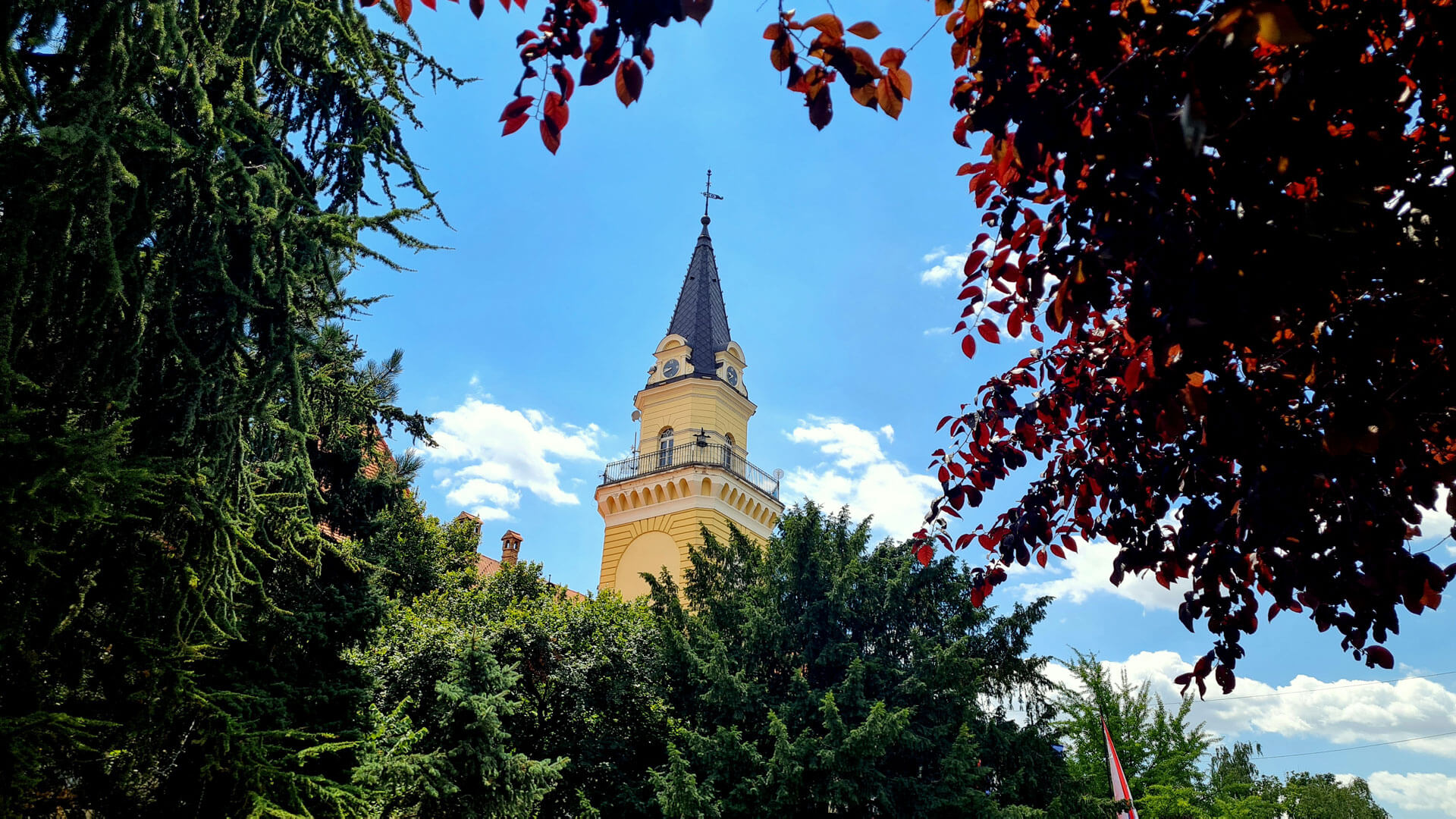
It’s hard to imagine exploring Subotica without visiting its best-known landmark. Built between 1908 and 1912, the City Hall is a masterpiece by architects Marcell Komor and Dezső Jakab, two of the leading figures of Hungarian Art Nouveau. The impressive building, crowned by a tower rising about 76 metres, dominates the city’s main square and has become one of Subotica’s defining symbols.
The interior is every bit as impressive as the exterior. Stained-glass windows, intricately carved woodwork, ceremonial halls and lavish ornamentation all bear witness to a time when Subotica was one of the wealthiest cities in this part of the Austro-Hungarian Empire. The most famous room is undoubtedly the Blue Hall, which still hosts official receptions and important civic events today.
For most visitors, however, the greatest attraction is the viewing platform at the top of the tower. Reaching it requires climbing quite a few steps, but the effort is more than worthwhile. From the top, you’ll enjoy sweeping views over Subotica’s red rooftops, its many church towers, the endless plains stretching towards the horizon and, on a clear day, even the Hungarian border.

Of course, I couldn’t resist climbing to the top myself. The view completely changes your perception of the city, because only then do you realise how carefully Subotica was planned and how harmoniously its Art Nouveau buildings fit into the urban landscape.

Once you’ve made your way back down, it’s worth spending some time in the main square itself. Here you’ll find the National Theatre, the fountain, numerous cafés and restaurants, while it’s slightly surprising to discover a McDonald’s occupying part of the ground floor of the City Hall. That unusual combination of more than a century-old monumental architecture and everyday city life gives Subotica a charm all its own.

This is where you’ll truly experience the city’s rhythm. During the day, the square is filled with tourists, local residents and families with children, while in the evening it becomes a favourite place for strolling, meeting friends and simply enjoying the atmosphere. It also serves as the perfect starting point for exploring the rest of Subotica’s remarkable landmarks.

Subotica Synagogue – A Masterpiece of Hungarian Art Nouveau
If you’re making a list of the best things to do in Subotica, the Synagogue will almost certainly be near the very top. Built in 1902 to the designs of Budapest architects Marcell Komor and Dezső Jakab—the same duo who would later design the City Hall—it is now regarded as one of Europe’s finest examples of Art Nouveau religious architecture and the only synagogue of its kind to incorporate Hungarian Art Nouveau elements so completely.
The building immediately captures your attention with its richly decorated façade adorned with floral motifs, Zsolnay ceramics and a magnificent central dome supported by iron columns. Inside, stained-glass windows, painted walls and decorative elements inspired by Hungarian folk art—peacock feathers, tulips and stylised flowers—create a truly remarkable interior. Originally, the synagogue could accommodate around 1,400 worshippers, reflecting the importance of Subotica’s Jewish community at the time. After decades of neglect, it underwent a thorough restoration and reopened to visitors in 2018.

Even before stepping inside, it’s obvious that something extraordinary awaits you if the exterior is this beautiful. Photographs can capture the building’s elegance, but they cannot convey the feeling of standing beneath its enormous dome as coloured light filters through the stained-glass windows. Despite its impressive size, everything feels light, airy and almost pastel in tone.

Take your time and absorb as many details as possible. The longer you study the walls and ceiling, the more ornaments and colours you’ll notice that escaped your attention at first glance. This isn’t a place to simply walk in, take a few photographs and leave. It’s worth pausing, sitting down for a moment and soaking in the atmosphere of one of the most beautiful sacred spaces I’ve visited anywhere in Serbia.
The Synagogue is only a few minutes’ walk from the main square, making it easy to include in your city walk. For that reason alone, it deserves a place on every itinerary of things to do in Subotica.

Cathedral of St Teresa of Ávila in Subotica
One of the city’s squares is dominated by the monumental Cathedral of St Teresa of Ávila, the largest Catholic church in Serbia. Built between 1773 and 1779 in the Late Baroque style to the designs of architect Franz Kaufmann from Pest, its twin bell towers, each around 64 metres high, have stood for centuries as one of Subotica’s best-known landmarks and a reminder of the city’s importance as early as the eighteenth century.
The cathedral’s spacious nave, richly decorated altars, valuable paintings and magnificent organ have long served as the setting for both religious services and concerts. Dedicated to the Spanish saint Teresa of Ávila, it has played an important religious and social role for the Catholic community of Bačka throughout its history. At the time of writing, the cathedral is closed for restoration.

One of the things I particularly enjoyed was how close everything is. Within just a few minutes’ walk you’ll find the City Hall with its Blue Fountain, the Synagogue, Raichle Palace and many other attractions. There’s no need to plan a specific route—simply start walking and almost every street will lead you to another fascinating building.
The cathedral may not be as elaborately decorated as the Art Nouveau palaces for which Subotica is famous, but its harmonious Baroque architecture provides a beautiful contrast to the colourful façades surrounding it. That alone makes it well worth including on any list of things to do in Subotica.

St Roch’s Chapel
Among the places worth visiting when exploring things to do in Subotica is St Roch’s Chapel, one of the city’s oldest surviving religious buildings. It was built in 1738, shortly after a devastating plague epidemic struck Subotica a few years earlier. The townspeople dedicated the chapel to St Roch, the patron saint of plague victims and those suffering from infectious diseases, in gratitude for the end of the epidemic. Although it has been restored several times over the centuries, it has preserved both its distinctive Baroque appearance and its historical significance. Today, it is protected as an important cultural monument and stands as a reminder of one of the most difficult periods in the city’s past.
The chapel’s exterior is modest and understated, making it quite different from the lavish Art Nouveau buildings for which Subotica is famous. Yet it is precisely this simplicity that gives it its special charm. Despite its small size, it has served for centuries as a place of prayer and remembrance, commemorating one of the darkest chapters in the city’s history. Many people walk past without realising the remarkable story preserved within its walls.

I particularly liked the fact that the chapel stands in a quieter part of the city, away from the busiest tourist areas. After exploring grand palaces and lively squares, it was refreshing to pause somewhere with a completely different atmosphere. There are no crowds of people taking photographs here, no constant noise—just a peaceful setting that naturally encourages you to slow down.
Places like this often leave a stronger impression than many of the city’s better-known attractions. Of course, you’ll probably also stop by more modern places such as McDonald’s—if only to admire its unusual interior—but historic monuments like this deserve your attention as well. St Roch’s Chapel may not be one of Subotica’s most famous landmarks, yet it reminds us that the history of a city is shaped not only by magnificent palaces and grand squares, but also by buildings that have quietly preserved the memory of events which profoundly influenced the lives of its people. For that reason, I would wholeheartedly include it among the places well worth visiting in Subotica.

Demeter Palace in Subotica
If you pay close attention to the façades while strolling through the city centre, it’s almost impossible to miss the elegant Demeter Palace, now home to the Subotica City Museum. Built in 1906 for the distinguished physician Dr Max Demeter, the palace was designed by brothers Lajos and József Vág, among the leading architects of Hungarian Art Nouveau. Unlike the richly decorated Raichle Palace, this building is characterised by cleaner lines and geometric motifs typical of the Vienna Secession.
The palace was remarkably modern for its time. The ground floor originally housed shops and a printing house, the owner’s apartment occupied part of the building, while spacious flats on the upper floor were rented out. Today, it accommodates the City Museum, whose collections of archaeology, history, ethnology and fine art make it one of the best places to discover Subotica’s past.

One of the things I particularly enjoyed was how easy it is to compare Hungarian Art Nouveau and the Vienna Secession side by side. The City Museum building isn’t as playful or flamboyant as Raichle Palace, yet that’s precisely where its beauty lies. The longer you look at it, the more you notice its carefully considered details, harmonious proportions and understated elegance, making it one of the most beautiful buildings in the city centre.

And once you start paying attention to the architecture, you’ll quickly realise that almost the entire city centre feels like an open-air museum. During your walk, you’ll also come across the former Savings Bank, the Grammar School, the Austro-Hungarian Bank, the Vojnić Palace, as well as numerous private houses and commercial buildings adorned with floral ornaments, ceramics, wrought iron and the elaborate decorative details that have become synonymous with Subotica. Thanks to this exceptionally well-preserved architectural ensemble, many people consider Subotica to be Serbia’s finest Art Nouveau city.
And then, just when you think you’ve seen it all, you unexpectedly come across the Plumber sculpture standing in the middle of the pavement…

Kelebija Stud Farm
Just 15 kilometres from the city centre lies Kelebija Stud Farm, one of the most beautiful places near Subotica for nature lovers and horse enthusiasts. Established in 1993 with the aim of breeding and preserving noble Lipizzaner horses, the farm now also raises elegant Andalusian horses. Over the years, it has grown into a popular tourist complex that includes the stud farm itself, a traditional farmstead, a villa, a restaurant, a museum and a variety of attractions for visitors.
Guests can tour the stables, meet the horses, watch training sessions or enjoy a horse-drawn carriage ride through the surrounding countryside. The fascinating Carriage Museum displays historic carriages, horse equipment and numerous artefacts recalling the days when horse-drawn transport played an important role in everyday life across Vojvodina. The stud farm is also well known for preserving the traditions of the Vojvodina farmsteads.

This was a completely different experience from exploring the city itself. After wandering through Art Nouveau palaces and lively squares, it was wonderful to spend a few hours surrounded by nature. The highlight of the visit was undoubtedly the carriage ride through the forest which, according to local tradition, was originally planted during the reign of Empress Maria Theresa. The sound of horses’ hooves on the sandy paths, the scent of the forest and the gentle pace of the ride briefly transported us back to a much slower way of life.

Be sure to visit the Carriage Museum, where you’ll gain a fascinating insight into the history of horse-drawn transport and horse breeding in this part of the Bačka region. Afterwards came the most delicious part of the day—lunch at the farmstead. I couldn’t resist trying the famous Coachman’s Soup, hearty, fragrant and exactly the kind of meal you crave after spending several hours outdoors. If you’re looking for things to do in Subotica and its surroundings, Kelebija Stud Farm is definitely worth adding to your itinerary.

Lake Palić
It’s almost impossible to write about things to do in Subotica without mentioning Palić, located just eight kilometres from the city centre. This well-known resort has been developing since the second half of the nineteenth century, when Lake Palić became a favourite spa destination and holiday retreat for the aristocracy and wealthy citizens of the Austro-Hungarian Empire. Today, it is one of the most visited destinations in Vojvodina, celebrated for its combination of nature, Art Nouveau architecture and wonderfully relaxed atmosphere.
The best-known attractions are found along the lakeshore. Among them are the iconic Water Tower, the Grand Terrace, the Men’s Lido, the Women’s Lido, the Music Pavilion and the beautifully landscaped promenade stretching along much of the lake. Nearby, you’ll also find Palić Zoo, one of Serbia’s finest zoological gardens, as well as numerous hotels, restaurants and wine cellars that further enrich the area’s appeal.

After exploring Subotica, it was the perfect place to end the day. The pace of life here is completely different. There’s no city bustle—everything unfolds slowly, accompanied by the rustling of tree canopies and the peaceful view across the calm waters of the lake.

The two of us spent the late afternoon strolling leisurely along the shore. The sun was already low, people were sitting in restaurant terraces or walking with their families, and the whole place had that wonderfully relaxed atmosphere that makes you forget about time. We finished the day with an ice cream while gazing across the lake, enjoying a typical summer evening at Palić.

If you have enough time, I’d recommend setting aside at least half a day for Palić. Only then will you understand why almost every visit to northern Bačka ends here—a place where architecture, nature and the slower rhythm of life in Vojvodina blend together perfectly.

A Few Final Thoughts
I saved what I believe completes every journey until the very end—good food and an unhurried stroll through the city. One place I would happily return to is Basch House 1887, where I enjoyed an excellent cake with my coffee. (They also brew their own beer and even have a distillery in the basement.) As I wandered through the city centre afterwards, I was reminded once again how Subotica encourages you to slow down and look up, because some of its most beautiful details are hidden above shopfronts and old street lamps.

If you’re in the mood for a proper lunch or dinner, Subotica also offers something quite different from what you might expect. One of my pleasant surprises was Konoba Tinel, serving authentic Dalmatian seafood—a rather unexpected but remarkably successful combination with the atmosphere of Vojvodina. And as the day draws to a close, there’s nothing nicer than finding a table at one of the cafés along the main promenade. With a gentle breeze, the murmur of the city and magnificent architecture all around you, it’s easy to understand why Subotica is a place that should never be explored in a hurry.

During my stay, I was based at Hotel Patria, right in the city centre, which proved to be an excellent choice since almost every attraction was just a few minutes’ walk away. Thanks to its location, there was no need for a car or even to think about parking. Of course, Subotica now offers a wide selection of hotels, apartments and other accommodation to suit every budget, many of which can easily be booked through Agoda (see below). Whether you’re visiting for a weekend or planning to spend several days exploring northern Bačka and Palić, I’m sure you’ll have no trouble finding a place that suits you. And when it’s time to leave, chances are you’ll already be thinking—just as I was—about when you can come back.
Next from Serbia: HOW KIKINDA SURPRISED METhe full Serbia Series: THINGS TO DO IN SERBIA